
Table of Contents
- What Makes a Graphene Plasmonic Nanoantenna Special?
- How Resonance Turns a Graphene Sheet Into an Antenna
- A Phased Array the Size of a Grain of Sand
- Turning Light Into Plasmons With a Gold Nanorod
- Metal Graphene Hybrid Antennas That Can Switch On and Off
- The Frontier of Plasmonics and Metamaterials
- Find Out More
Tiny Little Antennas That Bend the Light
If the cosmos has a sense of humour, it shows it in scale. Massive galaxies swirl for billions of years, while at the bottom of the size chart we have antennas so small they make a grain of dust look like a couch.
And yet, these microscopic antennas do something astonishing. They grab passing electromagnetic waves, convert them into ripples of energy along a sheet of graphene, and send them on their way with remarkable precision.
These are graphene-based plasmonic nanoantennas, and they may reshape how we move data, harvest energy, and build miniature sensing networks.
1. What Makes a Graphene Plasmonic Nanoantenna Special?
A graphene-based plasmonic nanoantenna, often called a GPN, can operate at millimeter radio wavelengths while being far smaller than traditional antennas.
When electromagnetic waves strike graphene, they excite charge oscillations along the surface. These oscillations interact with the material beneath, forming surface plasmon polaritons, waves where electrons and electromagnetic fields move together.
The wavelength of this plasmon wave is hundreds of times shorter than the original electromagnetic wave. This extreme compression lets graphene antennas operate at very low frequencies while remaining microscopically small.
Compared to conventional antennas, GPNs can operate quietly, efficiently, and at far smaller scales while producing only a fraction of the photon output.
2. How Resonance Turns a Graphene Sheet Into an Antenna
When an electromagnetic wave hits graphene, the sheet begins to oscillate. These oscillations couple with the dielectric material beneath, forming surface plasmon polaritons.
Resonance occurs when the antenna geometry allows an integer number of plasmon wavelengths to fit inside its shape. At that point, coupling becomes extremely strong.
It is like blowing across the top of a bottle. When the frequency matches the bottle’s natural resonance, the sound amplifies. Here, a sheet of carbon atoms replaces the bottle.
3. A Phased Array the Size of a Grain of Sand
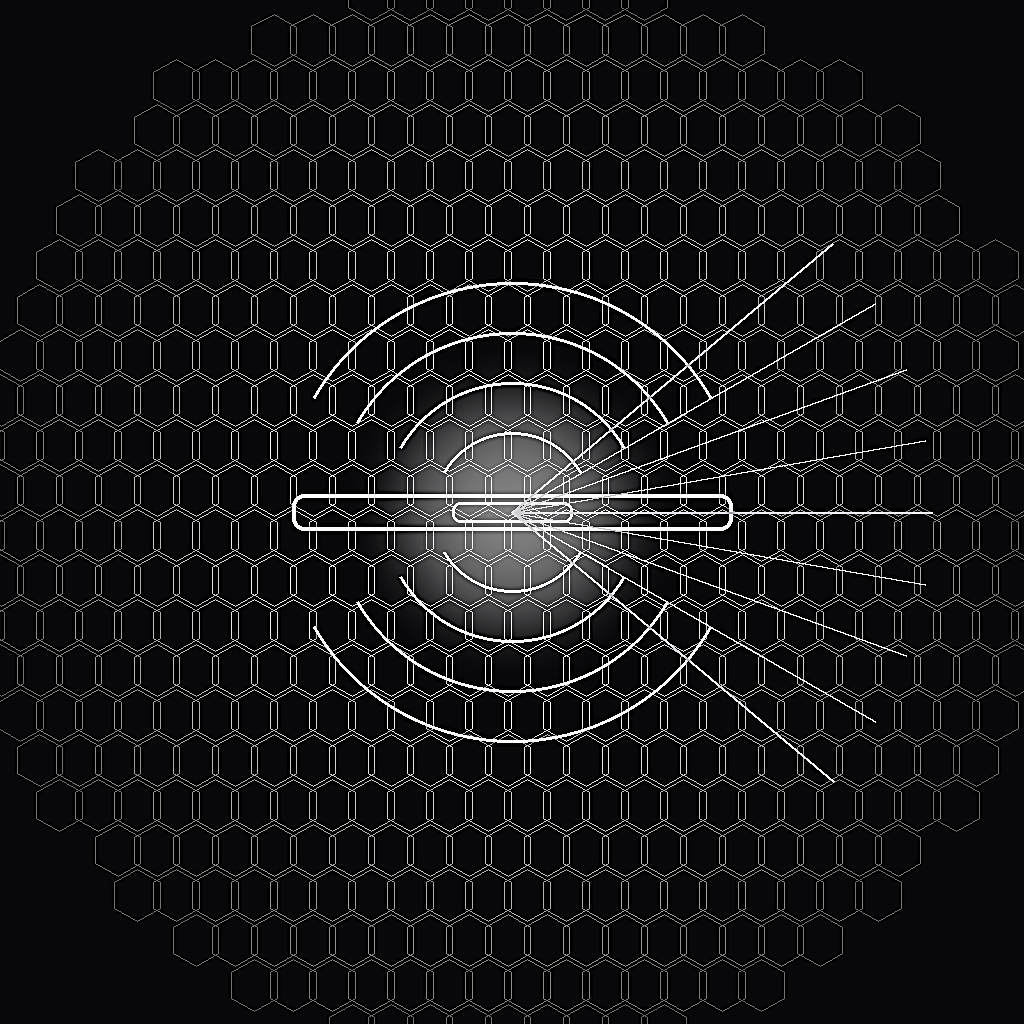
One striking demonstration is a phased array antenna only 100 micrometers in diameter. That is about the thickness of a human hair.
Yet this tiny structure can generate beams at 300 gigahertz that are only a few degrees wide. A conventional metal antenna of the same size would radiate in a very wide pattern.
- Smart dust sensor networks
- Ultra low power terabit wireless systems
- Advanced photonics and optical routing
This kind of beam control at microscopic scale makes dense, invisible communication networks suddenly plausible.
4. Turning Light Into Plasmons With a Gold Nanorod
Researchers have also used tiny gold rod antennas to capture incoming electromagnetic energy and convert it into graphene plasmons.
By shaping the antenna, scientists can steer these plasmon waves. Curve the antenna and the waves focus. Shape graphene into a prism and the waves refract.
The effect comes from differences in conductivity between graphene layers, creating a nanoscale version of bending light through glass.
5. Metal Graphene Hybrid Antennas That Can Switch On and Off
Hybrid metal graphene nanoantennas use a thin oxide layer between a gold nanorod and graphene to control energy flow and reduce losses.
By adjusting the chemical potential of graphene using a field effect design, researchers can toggle how graphene and metal plasmonics couple together.
This creates tunable antenna modes that can be switched on or off simply by changing voltage, turning the antenna into a tiny gatekeeper of waves.
6. The Frontier of Plasmonics and Metamaterials
Graphene nanoantennas sit at the crossroads of plasmonics and metamaterials. With their tunability, tiny size, and strong wave confinement, they are likely to become key components in future communication systems, sensing platforms, and photonic circuits.
These antennas do not just transmit signals. They shape how electromagnetic systems are designed at the smallest scales.
7. Find Out More
If discoveries like these fascinate you, explore our other articles on graphene science, energy systems, and advanced materials. Each breakthrough brings us closer to a world where the smallest devices make the biggest difference.