
1. What Graphene Brings to Defence Materials
Graphene-enhanced composites combine carbon’s clever atomic structure with advanced engineering. What does that get you in real life?
- Substantial weight reduction: GC claims vehicle armour that meets serious ballistic and blast standards yet is up to 30 percent lighter than traditional armour. That boosts mobility and reduces strain.
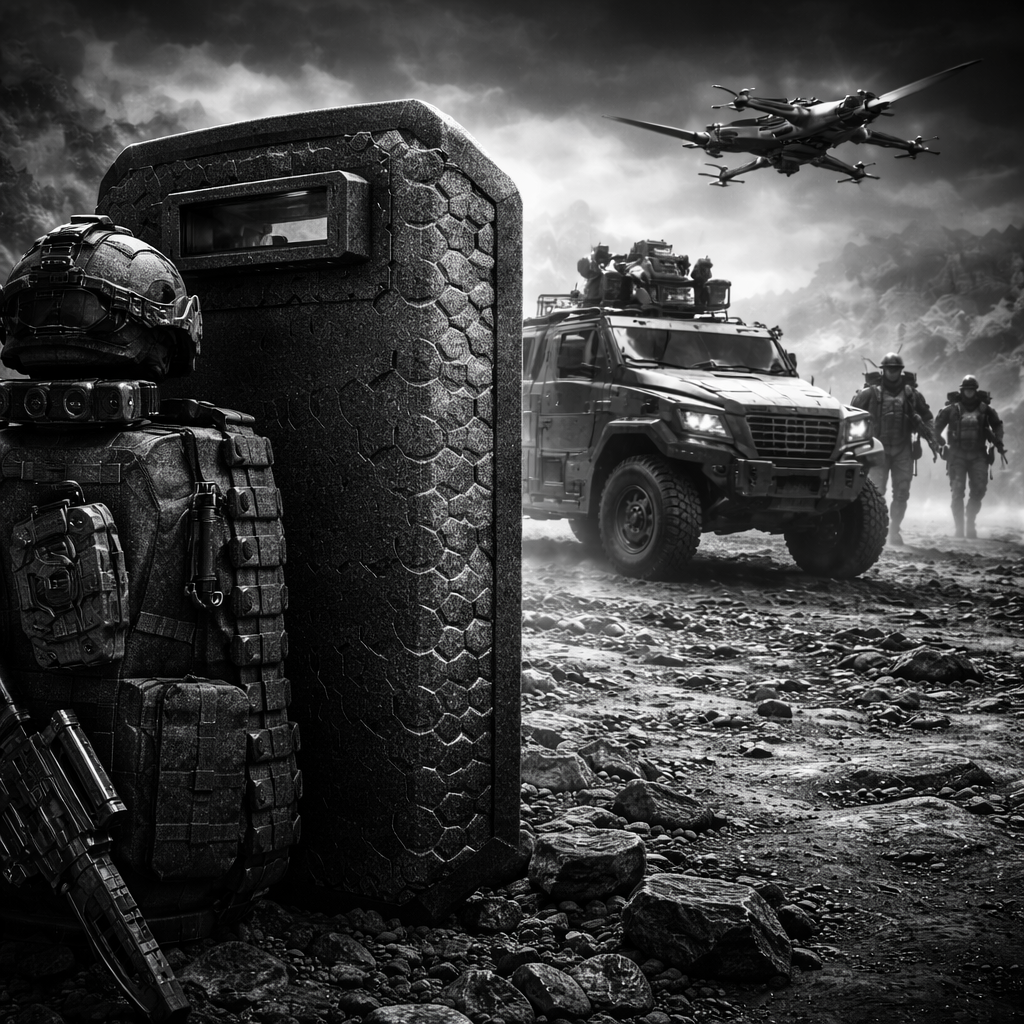
- High-performance ballistic protection: The RF2 Shield is rated to stop threats like the 5.56 × 45 mm M855 round, a common NATO rifle cartridge. The shield is positioned to deliver multi-hit protection and withstand edge shots, stacked rounds, and other high-threat scenarios.
- Blast resistance for vehicles: The composite technology extends to armoured vehicle panels, offering STANAG 4569 Level 1 to 3 protection while aiming for lighter and stronger panels than steel or ceramic-based armour.
- Mobility and modularity: Lightweight shields and modular panels can be rapidly deployed, carried longer, and configured as shield walls, which is critical in dynamic combat or tactical scenarios.
- Force dispersion and impact resistance: Graphene-enhanced, aerogel-based composites are designed to disperse impact energy more effectively than conventional materials, reducing trauma from blunt force, ricochet, or edge shots.
2. Real Products and What They Do
2.1 The GC RF2 Shield for Personnel
The RF2 shield is a next-gen ballistic shield designed for law enforcement, special forces, and defence units. It is positioned to exceed standard protection levels such as NIJ Level III and offer protection against high-threat rifle rounds like the NATO standard-issue 5.56 × 45 mm M855, even under multiple hits or edge-impact scenarios.
Because the shield is ultralight, it can improve mobility and endurance compared with traditional steel or ceramic shields. This translates to faster tactical deployment and better performance in high-threat environments.
2.2 Vehicle Armour Solutions
For armoured vehicles, GC provides composite armour solutions that aim to reach comparable protection levels to traditional steel or ceramic armours, but with a considerable weight advantage. According to GC, their panels meet STANAG 4569 Level 1 to 3 standards, which cover ballistic threats, small arms fire, and certain blast scenarios, while reducing hull weight and improving survivability.
Lighter vehicles with equivalent protection can improve fuel efficiency, mobility, and maintenance cycles. It reduces stress on suspension, lowers overall transport costs, and may expand tactical flexibility, especially in rugged terrain or rapid-deployment contexts.
2.3 Modular and Specialized Applications
Graphene composites are not limited to shields and vehicles. The material’s adaptability makes it a fit for:
- UAVs and unmanned ground systems requiring lightweight, impact-resistant panels
- Deployable barriers or temporary fortifications where ease of transport and high protection are both required
- Equipment and gear designed for extreme environments, including cold weather where standard materials can become brittle or degrade
3. Why This Changes Things
If you think of conventional armour as a heavy shield made of iron and fire, graphene-composite armour is like a cosmic fabric: strong as steel, light as a feather, and built from carbon’s most basic building blocks.
Lower weight means greater agility. Greater survivability means longer mission lifespan. Scalable composites mean the possibility of broader deployment, not only for elite units, but for larger defence infrastructure.
Imagine infantry moving faster, vehicles consuming less fuel, drones deploying shielding that withstands rifle fire, and military infrastructure that blends resilience with practicality. Companies like Graphene Composites suggest that future could be closer than we think.
4. Challenges and What to Watch
- Scaling production: High-quality graphene, properly embedded in a composite matrix at scale, remains expensive and logistically challenging. Supply chain and consistency are key concerns.
- Field validation: Lab ratings and certifications must be proven under diverse real-world conditions, including harsh weather, repeated impacts, and wear over time, before widespread adoption.
- Cost vs benefit: Decision-makers must weigh cost, manufacturing complexity, and long-term maintenance against known performance of steel or ceramic armour.
- Integration with legacy systems: Existing platforms are designed around metal or ceramic solutions. Retrofitting new materials can require re-engineering mounting systems, maintenance procedures, training, and logistics.
These are not small challenges. But materials often define eras. Steel shaped the 20th century. If graphene composites deliver on their promises, they could help redefine defence for the 21st century.
5. Closing Thoughts: The Quiet Strength Of A New Shield
Graphene composites in defence are more than just lighter armour. They are a glimpse of a future where protection, mobility, and technology merge into a seamless system. Where soldiers and vehicles do not sacrifice ability for safety. Where every piece of gear is engineered not just to resist, but to endure, adapt, and perform.
If that sounds like science fiction, perhaps it is. For now. But like all advances, the future begins in labs, in testing halls, and in moments of quiet determination. Graphene composites may well be the next material revolution – not with a bang, but with the steady hum of progress.
If this topic sparked your curiosity, check out some of the other recent posts, with topics on how graphene powers next-generation energy systems, to how it is reshaping electronics, coatings, and biotechnology